01
Contact Us
Once you contact us, you will speak with one of the owners, Alex or Carmen, to discuss your business goals.
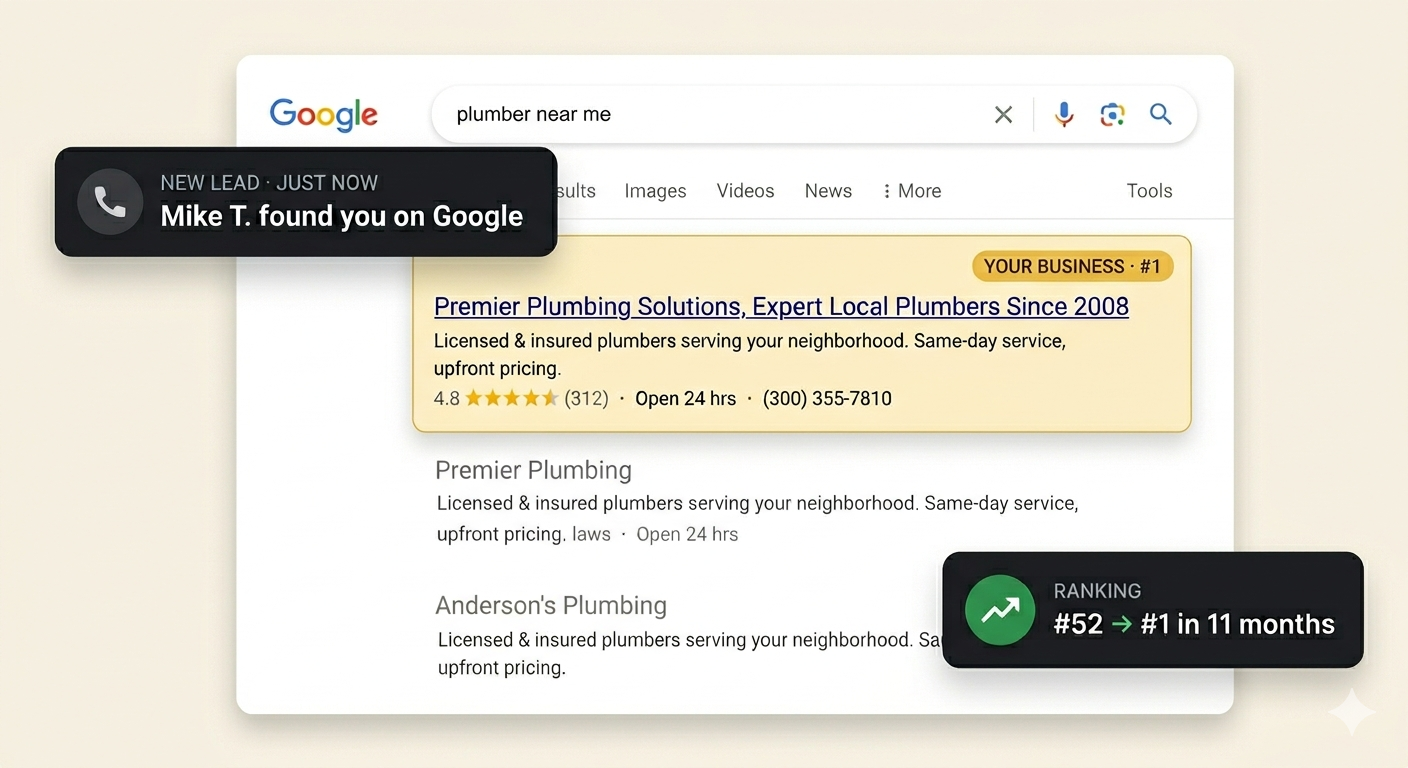
When was the last time you went to page 2 of Google to look for something? Our guess is it has been a while.
If your business is not being shown in the top-3 results of Google, you may as well be invisible. And with the increasing popularity of AI search, showing up there could determine the future of your business.
Your business needs a local SEO team that stays up to date with current trends, works directly with their clients to grow their business, and is an industry leader in local SEO. Contact us to see how we can help your business.
How do you know if you need local SEO services? You may need the help of a local SEO company if:
Once you contact us, you will speak with one of the owners, Alex or Carmen, to discuss your business goals.
From there, we will do an audit to analyze your website, on-site and off-site factors, competition, Google business profile, and more.
After our audit is complete, we will discuss our findings and map out a custom strategy catered towards your business.
No, and any company that does is overpromising. We focus on what we can control for our clients so their business has the best possible chance of ranking above competitors.
We will tell you honestly whether switching makes sense, whether it is worth keeping the current company and adding to it, or whether the current setup already covers what is needed.
No. The work is focused on legitimate citations, real local listings, and links earned from sources that fit the trade. Spam links can lead to manual penalties, and recovery from that is harder than building authority the right way.
By the client's bottom line. Are we helping the business grow and make more money? That is the metric we care about most. We still show SEO stats along the way so you can see what is improving, but the real goal is revenue growth.
Profile cleanup, technical fixes, and clearer service pages can show movement in the first one to two months. Ranking gains for competitive terms in established markets usually take three to six months of consistent work. The proposal spells out which gains are quick and which are longer builds.
Most of the work in the first three months builds the foundation for the gains that show up over the rest of the engagement. Shorter terms reward short-term thinking and produce short-term results.
SEO pricing varies by client based on the market, competition, and scope of work. Most clients land between $1,500 and $2,500 per month.
★★★★★ 5 stars on Google
★★★★★
“Been working with Cam and Alex for the last few months very highly recommend their services. So far they have over delivered on my expectations of the services that they provide and their attention to the little things and making sure that all of your information lines up.”
★★★★★
“I’ve worked with the owner of Workbench SEO in a previous professional setting and can confidently speak to their professionalism, communication, and work ethic. They are responsive, detail-oriented, and genuinely committed to delivering high-quality results.”
★★★★★
“Carmen and Alex are great. They have a wealth of knowledge and strategies to help your business no matter what it is. If you’re on the fence about it don’t think twice, it will be the best move you can make for your business.”
★★★★★
“I had an excellent experience working with Alex and Carmen. Their expertise in online marketing and business page management has made a significant difference for my business. They were professional, responsive, and took the time to understand my goals before creating a strategy tailored to my needs.”
★★★★★
“Before they started Workbench SEO, Carmen and Alex helped me see the value in Google and marketing. I was 100% referral business before but I needed more volume. I didn’t realize how building a local brand and having leads come just from being online helped.”
★★★★★
“Carmen and Alex are great to work with! If you are looking to optimize your business ideas, look no further than workbench!”
★★★★★
“Carmen is incredibly knowledgable and an absolute pleasure to work with. She came to our meeting prepared with strategies that were not only tailored to my business, but to my communication style and capabilities. I was so impressed and look forward to working with her more.”
★★★★★
“During our very first meeting, Carmen shared a targeted strategy that changed everything. Within 24 hours of implementing it, I generated 30 new Facebook leads—all subscribed to my newsletter!”
★★★★★
“Her knowledge about building websites, and different marketing platforms and strategies is so accurate and focused on the specific business. She understood my business so well and applied all her knowledge very accurately and personalized.”
★★★★★
“These guys completely reworked my website and networked all of my profiles together cannot praise the work that they've done enough highly recommend them if you're looking for SEO and website management”
★★★★★
“Working with this team has been a fantastic experience! Their turnaround and response time are top notch — we had a time sensitive issue on our website and they jumped on it immediately, even fixing it complimentary because they understood how urgent it was for our business.”