
Every serious local service business in the Philadelphia suburbs has a website. Most of those websites are barely showing up on Google. That's the gap this report sets out to explain.
Between April and May 2026, Workbench SEO audited 90 contractor and local service business websites across five counties in the Philadelphia area - Bucks, Montgomery, Lehigh, Berks, and Hunterdon. We covered nine trades: HVAC, plumbing, roofing, electrical, general contractors and remodelers, landscaping, moving, cleaning, and property management. We measured technical SEO, Google Business Profiles, Ahrefs1 organic visibility data, sitemap page depth, top page results, and a hand picked backlink2 source audit. The full methodology is at the end of this report.
"The companies with the strongest visibility are not doing one magic thing. They are consistently building the proof, pages, profile activity, and authority that make them easier to find and easier to trust."
The 8 sections of this report
The winners and losers of local search.
- The average local contractor in our sample had 32 estimated monthly organic visits and 1 keyword ranking in Google's top three positions.
- Five domains, about 6% of the sample, captured an estimated 59% of all the organic traffic across 85 audited local sites.
- Ten domains had zero measurable organic traffic. Twenty-five had fewer than 10 estimated monthly visits. Over half the sample had fewer than 50.
We looked at 85 local contractor and service business domains across Bucks, Montgomery, Lehigh, Berks, and Hunterdon counties. The typical domain in that group had 32 estimated monthly organic visits3 and 1 keyword4 ranking in the top three positions of Google. In a world where 68.7% of clicks come from the top 3 results on Google and 96.98% of clicks occur within the top 10, unless a business is being searched by name directly, it's not likely being seen by searchers.
The Pareto Principle of Search
The Pareto Principle, also known as the 80/20 rule, says that roughly 80% of results come from 20% of a sample. The rule mostly applies in our sample.
- 5 of the 85 audited domains (~6%) had over 500 estimated monthly organic visits.
- Those 5 domains together captured an estimated 59% of all the organic visits across the 85-domain sample.
- The top 5 produced more estimated organic traffic than the other 80 domains combined.
The reverse is just as striking.
- 10 of the 85 had no measurable organic traffic at all.
- 25 of the 85, almost a third of the sample, had fewer than 10 estimated monthly organic visits.
- 53 of the 85, over half the sample, had fewer than 50 estimated monthly organic visits.
Most contractor websites in this sample are findable if you already know the company name. They are not actively pulling new search demand.
85 local contractor and service-business domains across Bucks, Montgomery, Lehigh, Berks, and Hunterdon counties. Two national/franchise outliers excluded.
Median local domain in the sample: 32 estimated monthly organic visits. Top 5 domains captured ~59% of all estimated organic traffic.
A side-by-side of how much organic search work the typical local domain is doing compared to the small group at the top.
The top 5 domains in the sample produced more estimated organic traffic than the other 80 domains combined: 7,803 visits versus 5,450.
The top four organic-traffic earners in our sample
| Domain | Est. monthly organic visits | Top-3 keywords |
|---|---|---|
| harringtonmovers.com | 3,082 | 189 |
| obriens-moving.com | 1,821 | 69 |
| goodmanplumbers.com | 1,243 | 19 |
| kbelectricpa.com | 1,141 | 117 |
Action items
- Pull your own Search Console data for the last 90 days and sort by clicks. If most of your visible search demand is your own brand name and a handful of company-specific queries, your website is not being found by Google on important keywords.
- Search Google for the services you sell, plus a town in your service area. Try searches like:
- "electrician near me"
- "best plumber doylestown pa"
- "emergency roofer bucks county"
- "hvac repair allentown pa"
- "kitchen remodeler montgomery county"
- "water heater replacement reading pa"
- "ev charger installer lehigh valley"
- "drain cleaning near me"
- "landscaping company flemington nj"
- "moving company doylestown pa"
- List how you got your last 10 customers. If most came from referrals, repeat work, or paid ads, your business may be leaving organic leads on the table from search.
Build an active marketing routine.
- Only 20 of 90 websites had named project pages and only 11 of 90 showed local memberships.
- Of the 89 sites we could check, only 36 showed recent visible owner responses to reviews.
- The strongest performers don't have a single magic asset. They have a habit of capturing proof from every job: photos, reviews, project notes, certifications, local memberships.
This section highlights the importance of being a vocal business, letting your brand be heard, and making sure customers AND Google know you are active and available.
In the audit, basic proof of who you are (testimonials, project photos, certifications) was present on most websites. Deeper proof of what you've actually done and where (case studies, named projects, local memberships) was missing on the vast majority. Showing visible proof, optimizing the content around target keywords, and telling the potential client a story is critical.
Of the 90 contractor and local service-business websites we audited:
Trust must be targeted and custom
A local service business's website needs to prove to the viewer and Google they can be trusted within seconds. Generic stock photo galleries, a paragraph of "we've been serving the area for X years" and a contact form is a website, but it's not proof and trust.
A page with five named, dated case studies in towns the searcher recognizes is much more effective. Think bathroom remodel in Quakertown completed March 2026, with photos, scope, materials, and a quoted client. Google can index5 it. The named towns become local relevance signals. The dates become freshness signals. The materials and scope become keywords that people actually search for.
The strongest local performers in the audit didn't have a single magic asset. They had a habit of capturing proof: photos from every job, a review request after every project, a write-up of unusual or notable jobs, certifications and brand affiliations displayed prominently, and local memberships that double as authority signals.
Examples of targeted case studies
Ten illustrative examples of the kind of named, dated, locatable case study pages Google can index and a real customer can verify.
- HVAC · Berks County Carrier heat pump install in Wyomissing, completed January 2026
- Plumbing · Montgomery County Tankless water heater replacement in Norristown, completed April 2026
- Roofing · Lehigh County GAF Timberline HDZ asphalt roof replacement in Bethlehem, completed October 2025
- Electrical · Bucks County 200-amp panel upgrade and EV charger install in Doylestown, completed March 2026
- Remodeling · Hunterdon County Kitchen remodel with quartz countertops and custom cabinetry in Flemington, completed November 2025
- Landscaping · Lehigh County Paver patio and dry-stacked retaining wall in Allentown, completed September 2025
- Moving · Berks to Philadelphia Three-bedroom move from Reading to Philadelphia, completed February 2026
- Cleaning · Montgomery County Post-construction deep clean of a new build in Ambler, completed January 2026
- Property Management · Hunterdon County Tenant turnover and re-leasing on a Lambertville duplex, completed March 2026
- Roofing · Hunterdon County Asphalt roof tear-off and reroof on a 1920s farmhouse in Clinton, completed June 2025
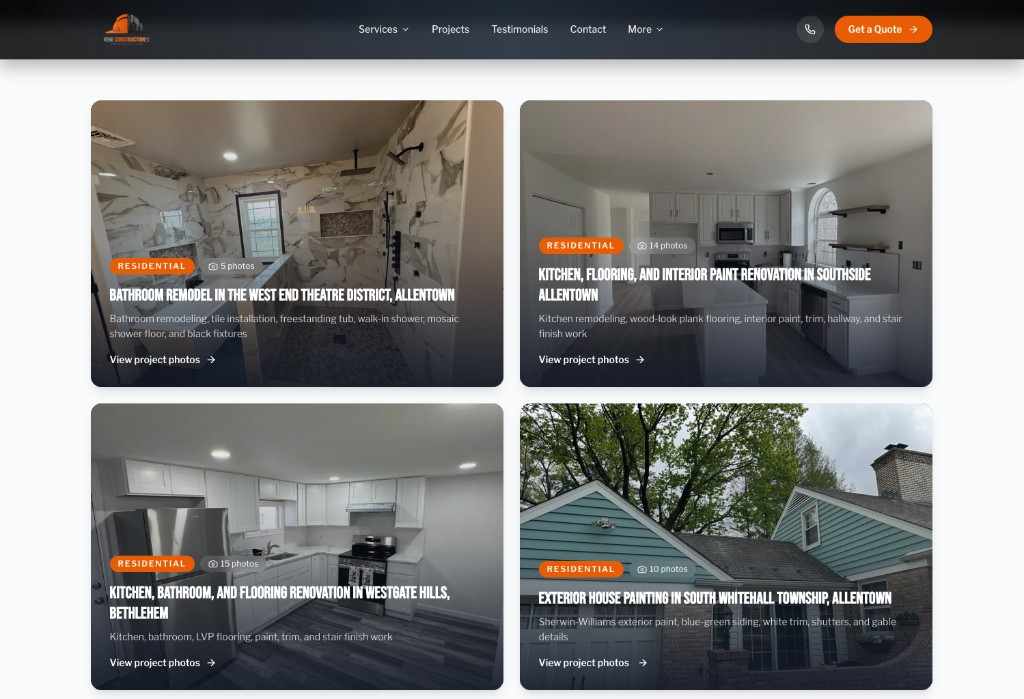
One of our most recent clients, Vene Construction LLC, based in Allentown, is a good example of how to build this routine. Vene Construction has developed the habit of sending daily project locations, photos, descriptions, materials used, and reviews. While they are newer to SEO, we anticipate their business to rise rapidly due to their newfound habits.
Action items
- Create a content-capture routine. Capture project photos or video, a short written summary covering the scope of work, service area, materials used, and outcome, and a review request for the customer.
- Create targeted pages for the important ones. Most photo galleries earn no search traffic on their own. A dedicated page for each notable project, with the scope, town, and date, gives Google something to index.
- Respond to reviews quickly and often. Owner replies to reviews are a real Google Business Profile ranking signal.
Backlinks and page depth.
- The strongest correlation6 with organic visibility was dofollow7 referring domains8 (0.628 with traffic, 0.674 with top-3 keywords). Local and high authority websites backlinking to a business directly is one of the most effective strategies the winners use.
- Page depth tracked visibility too. Sitemap URL count (0.478), location pages (0.457), service pages (0.416), blog/resource pages (0.407).
- The internal website-readiness score (all the basics like working forms, mobile responsiveness, clear service areas) tracked organic visibility least (0.205). Basics matter, but they don't separate the top group from the middle.
The data points to two basics: useful content for Google to match against keyword searches, and enough credibility from other websites linking back to the business.
We measured both, and ran them against the Ahrefs organic-visibility data for 85 local domains. The pattern is consistent. Authority signals, meaning the count of websites linking to a contractor's domain, tracked organic visibility more closely than anything else. Content depth (the number of useful pages on the site) tracked it next. The internal website-readiness score tracked it least.
Signals that correlated with organic visibility
| Signal | vs traffic | vs top-3 keywords | Explanation |
|---|---|---|---|
| Dofollow referring domains | 0.628 | 0.674 | Local and high authority websites backlinking to a business directly is one of the most effective strategies the winners use. |
| Domain Rating9 | 0.617 | 0.603 | Aggregate link authority scored similarly. |
| Total sitemap URL count | 0.478 | 0.471 | Deeper sites tracked higher visibility, but less strongly than authority. |
| Estimated location / service-area pages | 0.457 | 0.439 | Local page architecture tracked visibility when pages had real content. |
| Estimated service pages | 0.416 | 0.376 | Dedicated service pages tracked better than a single services hub. |
| Estimated blog / resource pages | 0.407 | 0.499 | Useful resource content tracked visibility, especially top-3 keywords. |
| Internal website-readiness score | 0.205 | 0.218 | The basics matter, but they don't separate the top group from the middle. |
Correlation does not equal causation. We are not claiming that adding 50 pages or buying 50 backlinks will move a business up the rankings. Low-quality pages and weak links can create more risk than value. The next section explains why local authority has to be legitimate.
More pages alone won't fix anything
The page count correlation is easy to misread. It's tempting to look at the 0.478 correlation and conclude "build more pages."
The right reading is that the strongest performers have useful pages. Dedicated services. Real local coverage with substance. Resources that answer real customer questions. Stuffing a sitemap with 200 thin location-by-keyword pages is the trick that used to work in 2014. It doesn't anymore. Google's bar for what counts as a useful page got higher every year, and it's still rising.
Action items
- Build the right authority. Backlinks matter, but they have to be high quality. See the next section for more.
- Authority and content are a pair. The industry leaders are creating the right content for their audience and building backlink authority in the right places cohesively.
- Audit your own site for the obvious gaps. If you have one services page covering all of your services, those need to be separated and targeted. If you don't have location pages for your key service areas, adding them will add a lot of value.
Authority, authority, authority.
- We pulled data across all 87 audited contractors and reviewed every site linking to them, 788 sources in total. Only 83 (about 11%) were real local authority: chambers, local newspapers, manufacturers, trade associations, or community organizations. The rest were directory listings, off-topic noise, or worse.
- Most contractor backlink profiles are misleadingly inflated by directory listings, low quality domains, and spam.
- The links that count come from chambers, trade associations, manufacturers, suppliers, local nonprofits, neighborhood organizations, and local press. Not from buying or building generic links.
Backlinks are usually discussed as a single number: the count of referring domains. That number describes how many other sites link to a site. As Google's algorithm has changed, quality over quantity is being rewarded more and more each update.
To look past the count, we pulled the top dofollow links pointing to each of the 87 contractor and service business sites in our audit, which produced 788 source-target pairs in total. We sorted each source domain into a category based on the type of site: real local authority (chambers, manufacturers, local newspapers, trade associations, community organizations), directory or citation listings, low quality or off topic, and unknown.
The category breakdown was consistent across the audit, regardless of which contractor we looked at.
Each segment shows the share of dofollow links across the full 87-contractor pull that fell into each category. Only the green segment looks like real local authority.
Roughly 1 in 10 of the dofollow backlinks in the full audit looked like real local authority. Half were citation or directory listings; the rest was low-quality or unclassified noise.
Why local authority is important for local service businesses
National directories pass authority but no relevance. Local sources pass authority, geography, and category verification.
- Local links carry geographic context. A link from
phillymag.comtells Google "this business is part of the Philadelphia-area economy." A national directory link tells Google nothing about geography. Local pack rankings ("plumber near me," "roofer in Doylestown") specifically weight regional link signals. - Local links carry category verification. A manufacturer's contractor finder (
bradfordwhite.com/contractors/...) confirms the business installs that brand. A directory listing is, at best, a self-claimed category; a manufacturer link is third-party verified. - Local links look earned. Directories look generated. Chambers, trade associations, and local press write about real businesses through real relationships. Google's spam detection systems have been progressively devaluing automated link sources for over a decade.
Examples of legitimate local authority
| Source type | Source domains |
|---|---|
| Local / regional media | phillymag.com · pottsmerc.com · readingeagle.com · timesherald.com · thereporteronline.com · centralbucksnews.com · dailylocal.com |
| Chamber / business association | berksconnect.com · greaterreading.org · hunterdon-chamber.org · chambergmc.org · tricountyareachamber.com · lvba.org |
| Manufacturer / vendor | bradfordwhite.com · gaf.com · certainteed.com · carrier.com · holganix.com · ugihvacenterprises.com · allied.com |
| Trade association | phcclv.org · hbaberks.org · ycea-pa.org · mhep.org · lvba.org |
| Community / nonprofit | moveforhunger.org · flemingtonelks.com · plumsteadbaseball.org · hillsboroughyouthsports.org · newtowngrant.org · middletownbucks.org |
"The Chamber of Commerce for Greater Montgomery County offers regional businesses unparalleled opportunity to increase visibility, engagement, and collaborative partnerships. We offer a variety of advertising modalities with a strong focus on digital exposure... We know that people prefer to do business with those they know, like and trust, so our programs focus on building meaningful relationships."
What this report doesn't claim
Directory links aren't worthless. Citations10 and local profiles play a real role in local search consistency, especially in a business's first few years online, however, they're not the kind of authority that drives top rankings on competitive local terms.
Not every chamber link is gold either, and a listing from a chamber that the business doesn't engage with is not as strong as being active in the chamber. The strongest local authority comes from real participation.
The 788-row dataset is the top dofollow, non-spam referring domains for all 87 audited contractors. Source domains were classified heuristically by domain name. Domain name based classification is good for first pass categorization but not perfect. Some domains classified as low quality may have legitimate uses we missed.
Action items
- Stop optimizing for the backlink count. The number that matters is the count of real local, trade, vendor, media, and community mentions.
- The shortest path to real authority runs through real relationships. Chambers, trade associations, manufacturers, suppliers, local nonprofits, neighborhood organizations. Make relationships in these organizations. Get listed in the business directories and work with them to deliver value to the community.
- Audit your existing backlinks the way Google probably does. Pull your referring domains in any free or paid SEO tool, sort by domain authority and relevance, and ask: which of these would I be proud to put in a sales deck? The honest count is usually 5-15.
All about keywords.
- In our top-page sample, blog and resource pages drove 2,252 estimated monthly visits, roughly a third of the traffic of the top 60 sampled pages.
- Almost a quarter of the visible organic traffic in the sample came from informational searches. People looking for answers, not yet ready to buy.
- The businesses showing up for those informational searches stayed in the consideration set when those searchers were ready to call.
A quick refresh on keywords. A keyword is a specific phrase someone types into Google. Reverse engineering what potential clients will be typing into Google and AI like ChatGPT, and building content around that is one of the most important components of SEO.
What are the questions you see homeowners ask? What are they searching for that your business can answer?
- How long does a bathroom remodel take?
- How much does it cost to replace a water heater?
- What does a deep clean include?
- How far ahead should I book movers?
- Why is my heat pump freezing up?
- How much does a roof repair cost?
- Can I install an EV charger at home?
- What size HVAC system do I need?
- How often should gutters be cleaned?
- What should I do after a pipe bursts?
Those aren't sales questions. They're search queries.
Every one of those questions gets typed into Google by someone before they ever pick up the phone. The businesses winning organic traffic in our audit are the ones whose websites already answer those questions: in service page sections, in FAQs, in short blog posts, in video clips on the site, in Instagram stories, in YouTube clips, sometimes in dedicated resource pages.
Top organic pages by content type
When we sampled the top three organic pages from each of the top 20 local contractor domains (60 pages total), the breakdown by inferred page type was telling:
| Inferred page type | Estimated monthly visits | Share |
|---|---|---|
| Homepage | 2,619 | 38% |
| Blog / resource | 2,252 | 33% |
| Location / service-area | 1,519 | 22% |
| Other | 414 | 6% |
| Service | 125 | 2% |
| Support / proof | 45 | <1% |
| Tool / calculator | 5 | <1% |
Blog and resource pages, the kind of pages that answer specific customer questions, accounted for roughly a third of the visible organic traffic in the top 60 sampled pages. Pure homepages still drove the most volume, but resource and location pages combined drove more than homepages did.
The same sample, broken out by what the searcher's intent looked like:
| Inferred keyword intent | Estimated monthly visits | Share |
|---|---|---|
| Service / local-commercial | 4,170 | 61% |
| Informational | 1,573 | 23% |
| Branded / company | 961 | 14% |
| Mixed / unclear | 275 | 4% |
Almost a quarter of visible organic traffic came from informational searches: people looking for answers, not yet ready to buy. The businesses showing up for those answers stayed in the consideration set when those searchers were ready to call.
Lead questions by trade
A few examples of the kind of question every trade hears regularly that should already be a published answer on the business's website:
- HVAC: "Why is my heat pump freezing up?"
- Plumbing: "What should I do if my water heater is leaking?"
- Roofing: "How do I know if I need a roof repair or a full replacement?"
- Remodeling: "How long does a bathroom remodel take?"
- Electrical: "Do I need a 200-amp panel?"
- Landscaping: "When should I start spring cleanup?"
- Moving: "How far ahead should I book movers?"
- Cleaning: "What's actually included in a deep clean?"
- Property management: "What does a property manager actually handle?"
One query, five content ideas
The businesses getting the most value from lead questions aren't writing one blog post per question. They treat each question as a content unit and produce five things from it.
- 1. Short video Explaining on a job, posted on social media and website.
- 2. FAQ entry Added to the matching service page on the website.
- 3. Blog post The longer answer for organic search.
- 4. Service-page section Adds depth to the existing page for SEO.
- 5. Social or email Distribution back to the resource you just made.
That's five linkable, indexable assets the business owns, all from one customer question. Each one reinforces the others.
Action items
- Make a list of the 10 questions you hear every week and don't answer in writing yet. Here is your list of content pieces to work on.
- Pick one question this month and produce all five assets for it. A 60-second video, a FAQ on the relevant service page, a blog post, a section in the service page, and a social post.
- Stop writing blog posts that aren't answering questions. Generic "spring is coming" posts have no search demand and no one's asking. Real lead questions have demand because real leads are asking them.
Is AI going to kill SEO?
- AI search does not make SEO irrelevant. It raises the standard for the same work: clear answers, useful pages, current proof, and third-party validation.
- Answer engine optimization (AEO) and generative engine optimization (GEO)11 are best understood as extensions of SEO, not replacements for it.
- AI search often uses query fan-out12: one prompt becomes many hidden checks about services, locations, prices, reviews, proof, risks, and next steps.
AI search is changing how people get answers. Ahrefs found that AI Overviews reduced clicks by 58%, which explains why the topic gets attention. The practical takeaway is less dramatic: AI search still relies on the same raw material SEO has always worked with, including clear pages, useful answers, credible proof, and trusted third-party sources.
When someone asks ChatGPT, Perplexity, Gemini, or Google AI Mode for help choosing a contractor, the system may break the question into smaller searches, retrieve pages from search indexes and other sources, compare what those sources say, and summarize the answer. Ahrefs' AI Search research describes this as a mix of training data, retrieval systems, live tools, and query fan-out working together.13
That matters because the AI layer rewards the same businesses this report keeps describing: businesses with clear service pages, real project proof, consistent Google Business Profile details, useful answers, local authority links, and third-party mentions. If the only thing online about a business is its own thin website, there is not much for Google or an AI answer system to confirm.
What changes when search becomes an answer
The biggest shift is that search engines and answer engines are getting better at checking multiple signals at once.
| AI search behavior | What it means for local service businesses |
|---|---|
| One question becomes many hidden searches. | Your site needs coverage across services, locations, proof, FAQs, costs, brands, and risks. |
| AI systems retrieve short passages as well as whole pages. | Each section should say the useful thing directly. Put the answer first, then support it with detail. |
| AI citations favor specific entities and clear relationships. | Name the service, town, material, brand, certification, project type, and problem. Vague "quality service" language gives machines and customers almost nothing. |
| Third-party sources help define the business. | Chamber pages, manufacturer finders, trade associations, local media, reviews, and directories all help confirm who you are and what you do. |
| Answers can reduce clicks on some informational searches. | Being mentioned, cited, and remembered matters more than before. The click still matters, but so does being one of the trusted businesses in the answer set. |
AEO rewards clarity and conciseness
Answer engine optimization sounds more complicated than it is. For a local service business, the goal is simple: make the page easy for a person, Google, and an AI answer engine to understand quickly.
That means putting the answer near the top, writing in plain language, using headings that match real customer questions, and repeating important details where they matter: service, town, problem, material, proof, and next step. A strong page should make it obvious who does what, where they do it, what proof exists, and how a customer starts.
- 1. Service Tankless water heater replacement, EV charger installation, storm-damage roof repair.
- 2. Location Doylestown, Norristown, Allentown, Reading, Flemington, etc.
- 3. Proof Project photos, named jobs, certifications, review excerpts, manufacturer affiliations.
- 4. Answer Plain language FAQs that answer the questions customers ask before calling.
- 5. Validation Chamber, vendor, trade, media, directory, and community sources that confirm the business exists outside its own website.
GEO is mostly authority and entity consistency
GEO, or generative engine optimization, is the broader version: making a business easier for generative systems to understand, retrieve, and cite.
If your website says you serve Bucks County, your Google Business Profile says something different, your directory listings use an old phone number, and no third-party sites mention your services, the entity is blurry. If your website, GBP, reviews, project pages, chamber profile, manufacturer profile, and local mentions are synchronized, you reduce that ambiguity. Answer systems are built to produce confidence quickly. Consistent signals make the business easier to understand and verify.
Right now, AI has not changed local search as much as the loudest claims suggest. That does not mean the change is small. We use AI every day in our own workflow where it helps with research, structure, and speed. The judgment still matters: the person doing the work needs to understand the business, verify the output, and adapt as search behavior changes.
Action items
- Do not chase every new AI search trick. The same fundamentals that make your business easier to find in Google also make it easier for AI tools to understand and cite.
- Make your best service pages answer-first. Start each important section with the answer, then add details: service, town, problem, material, timeline, price factors, and next step.
- Keep your entity footprint consistent. Make sure your website, Google Business Profile, directory profiles, chamber listings, vendor pages, and social profiles agree on your name, phone, service area, categories, and core services.
- Earn sources that can confirm you. Local media, chambers, trade groups, vendors, community organizations, and strong review profiles give both search engines and AI systems more evidence to work with.
Conclusion.
The pattern in this report is simple: most local service businesses have a website, but only a small group are turning that website into consistent search visibility.
The gap is not subtle. In the core 85-domain analysis, the median local domain had 32 estimated monthly organic visits and 1 keyword ranking in Google's top three organic positions. Five domains captured an estimated 59% of the total organic traffic in the sample. Ten domains had no measurable organic traffic at all.
The stronger pattern is practical: the businesses earning visibility have more useful pages, more visible proof, and more credible outside validation. They give Google more to index, give customers more to trust, and give AI search systems more clear information to retrieve and summarize.
The main takeaways
- Search traffic is concentrated. A small group of local businesses is taking most of the non-paid search traffic while the rest are mostly being found by people who already know their names.
- Build habits around marketing. Create content around photos, case studies, reviews, certifications, local memberships, and the questions your customers ask. Make this a habit that compounds.
- Authority and content work together. The strongest visibility correlations came from dofollow referring domains and useful site depth. That means building relationships and backlinks within the LOCAL community is the highest impact thing a business can do.
- AI search raises the same standard. Answer engines and generative systems reward clear service information, specific locations, proof, consistency, and third-party validation. They raise the standard for the same SEO work.
The practical conclusion is this: winning local search usually means making the business easier to find, easier to understand, and easier to verify than the competitors around it.
For a contractor or local service business, that usually means building a repeatable routine. Capture proof from real jobs. Turn important services and locations into clear pages. Answer the questions customers ask every week. Keep the Google Business Profile and website consistent. Build relationships that can produce real local mentions beyond directory listings.
The businesses that do this consistently give search engines more evidence. They also give customers a better reason to call. That is the part that matters most.
Methodology, limits, and source notes.
This report is based on a 90-business pilot audit of local contractors and service businesses in the Philadelphia suburbs and nearby markets. The audit combined manual website review, Google Business Profile observations, public Ahrefs estimates, sitemap checks, backlink-source classification, and a review of current Ahrefs AI Search research.
The goal was to understand what separates businesses that already show search visibility from businesses that are visible only in a limited way.
What we audited
- 5 counties: Bucks (PA), Montgomery (PA), Lehigh (PA), Berks (PA), and Hunterdon (NJ).
- 9 trades: HVAC, plumbing, roofing, electrical, general contractors and remodelers, landscaping, moving, cleaning, and property management.
- 90 businesses: 2 per county-trade cell (5 counties x 9 trades x 2). Selection used one "visibility leader" and one "opportunity sample" per cell, drawn from observed local search results.
- 87 unique domains after collapsing duplicates (some businesses operate the same domain across multiple county listings).
The sample is search-visible by design. Businesses that did not appear in the observed local search results were not included. The reality is likely more severe than the report suggests, because the lowest-visibility businesses in the market are not represented in the sample.
What we collected
Each business was reviewed across several public signals. The fields were chosen because they are visible to customers, visible to search engines, or commonly used by SEO tools to estimate organic visibility.
- Website basics: whether the site loads, uses HTTPS, explains the service above the fold, states the service area, shows a phone number, gives a clear quote/contact path, and has service, location, or county pages.
- Proof signals: testimonials, project photos, license or certification signals, named project pages, case studies, and local memberships.
- Google Business Profile observations: profile name, website URL, primary category, review count, average rating, visible owner responses, and consistency between the profile and the website.
- Ahrefs visibility estimates: Domain Rating, estimated organic traffic, organic keywords, keywords ranking in positions 1-3, referring domains, and dofollow referring domains for 87 unique domains.
- Top-page sample: the top three organic pages from each of the top 20 local domains by estimated organic traffic, for 60 pages total. These pages were classified by inferred page type and inferred keyword intent.
- Page-depth pass: sitemap URL counts and rough path-based estimates of service pages, location pages, blog/resource pages, and proof pages. Sitemaps were found for 82 of 87 domains.
- Backlink-source classification: 788 dofollow, non-spam referring-domain rows across the 87-domain pull, classified by source-domain type.
- Source-URL verification: selected source URLs were spot-checked to test the backlink classification logic, especially in the strong local-authority category.
- AI-search research layer: current Ahrefs AI Search articles were used to interpret how findings such as clear answers, entity consistency, citations, and query fan-out apply to local service businesses.
What we did not measure
- Homeowner preferences. We did not survey or interview consumers. Any claim about homeowner behavior is based on public search and website observations, not consumer research.
- Lead volume, conversion rates, or revenue. We did not have access to any business's analytics, CRM, call tracking, or financial data.
- Regular map-pack rankings. We reviewed Google Business Profile and entity signals, but we did not run recurring local map-pack rank tracking.
Important caveats
- Ahrefs estimated organic traffic is modeled. It is calculated from observed keyword rankings, search volumes, and click-through-rate models. It is not the same as Google Analytics, Search Console, call tracking, or booked-job data.
- Backlink classification is directional. Source domains were classified by domain name and spot-checked by source URL. That is enough for pattern analysis, but it is not the same as a full manual backlink audit for every business.
- Weak examples are not named. The report names public examples when they illustrate stronger patterns. Critical examples are described without naming the business.
Limitations
This is observational research using public and modeled data. The findings are useful, but they should be read with the limits below in mind.
- Search demand varies by trade. Moving and plumbing tend to have more direct search demand than some other categories. That can affect which trades appear near the top of the aggregate results.
- The sample is already search-visible. Businesses had to appear in observed local search results to be selected. Contractors that show up nowhere are outside the sample.
- The selection method creates a barbell. Within each county and trade cell, we selected one visibility leader and one opportunity sample. This helps compare stronger and weaker examples, but it is not a random sample.
- The report is a snapshot. The audit and Ahrefs data were collected in April and May 2026. The report does not show whether any individual business is improving or declining over time.
- Inputs were not controlled. We did not control for business age, marketing budget, agency support, county population, brand awareness, or referral strength. The report describes visible search outcomes and related patterns.
- Search visibility is not the same as business health. A contractor with low organic traffic may still have a strong referral pipeline. A contractor with high organic traffic may still have weak conversion. This report measures visibility, not revenue.
- Workbench SEO has an incentive. Workbench SEO publishes this report and sells SEO, web design, and paid ads. The data has been framed as honestly as possible, but readers should understand the business context behind the report.
Source files
The working dataset includes:
- 90-row audit data with 100 observed fields per row
- Ahrefs Batch Analysis results for 87 unique domains
- Top-pages sample with page-type and intent classification
- Page-depth sitemap pass for 82 domains
- 788-row dofollow referring-domain classification (full 87-contractor audit)
- Source-URL verification results
- External Ahrefs AI Search research used for Section 6 synthesis
Workbench SEO retains the underlying data and audit trail. Reporters, chambers, and trade press evaluating this report can request access to verify specific findings.
Who built this
This research was led by Alex Kim, founder of Workbench SEO. Workbench SEO is a marketing company serving contractors and local service businesses across Pennsylvania and New Jersey, with services including SEO, web design, and paid ads.
If this report raises questions about your own search visibility, visit workbenchseo.com or reach out to Workbench SEO. We can help identify which pages, proof, and local authority signals should come first for your market.
Here at Workbench SEO, we prioritize quality over quantity. We preach to our clients that in the new AI era of search, it's becoming increasingly important to put out content that is not a commodity and is valuable to readers and search. Because of this, all of our pieces will be curated for the reader in an attempt to always add lasting value. Please sign up for reports when they get published so you don't miss any.